Mannn… this session combining the power of The Paradox with the Comfort Zone Model contains profound transformations. Let’s try my memory of what riders achieved:
- Karin took us into deeeep healing.
- Cheryl blasted out into her Feel with a holy snappin’ turtles moment that will help others in similar circumstances and overwhelm.
- Catherine demonstrated the difference between being taught to sit up straight, cleaned up some stuff behind her perfect riding seat with her new horse and found the circuit of energy between horse and rider that the great riding masters talk of. How often do we struggle with the next horse after a comfortable soulmate? She’s bought a Pivo, so hopefully we’ll get to see some video of this taken out to her horse.
- Sandra found her “riding seat” that directly translated into the way her body can give her horse the perfect set of hands – spongey feel – when she’s driving him. After that session his stops were significantly improved.
- June found the holy grail of keen riders everywhere – the pulse, the circuit of energy between horse and rider. She also gave you a lovely technique for helping a horse to move forwards in their Comfort Zone when they haven’t had one with a rider on their back. I can’t wait to see some video footage of this taken out to her horse.
- Kim and I did some powerful work that will deeply resonate with anyone in need of healing and around weight issues.
The lesson:
When I talk about “that’s perfect” or “this is perfect” or “feel the perfection” of something I’m sure some of you will want to slap me – because you can’t remotely see how what you’re experiencing is perfect.
I once had a beloved friend send me an article where someone actually called it “evil” to seriously advocate that “everything happens for a reason”. And I get it. I get why they should think like that. Anything that should make it “reason..able” that people do unconscionable things and think it reason…able that ghastly things happen to good people, defenceless small children and animals – anything that could even faintly imply that … ugh… No, I get it. How can we explain some of the incredibly horrifying things that happen in the world and glibly say to ourselves “everything happens for a reason.” I can see the sheer arrogance of that.
But it’s a Paradox.
“Everything happens for a reason” is a paradox. A paradox is something that seems like a contradiction, but isn’t really. It SEEMS like a contradiction to say that there’s rightness behind even the most utterly wrong of wrongnesses, it SEEMS like a contradiction to say that there’s a rightness behind everything wrong thing that happens, it SEEMS like a contradiction to say what I’ve just said above and also believe that everything happens for a reason.
But it’s not a contradiction at all. The RIGHTNESS doesn’t in any way take away from even the most appalling WRONGNESSES that I talked about in the first paragraph – the rightness simply forms part of the whole.
I know this can be biiiggg, so let’s have a bit of a Feel into the Truth – or not – of it. Drop into your outward breath and notice all the ways that you feel inside your body. We’re not looking for an intellectual answer here, we’re looking for the answer to come up from the inside of you. Could it possibly be true that there’s a perfection, a rightness behind every wrongness you experience? And if that rightness behind the wrongness thing – the perfection of even crappy things – really is the source, the flow of all kinds of wonderful healing and problem solving and conflict resolution, if that were possibly true – would you want to know that?
The Paradox is an experience
Here’s why we want to work out the truth or not of this stuff for ourselves. It’s because the Paradox isn’t a mind thing. It’s not an idea or a concept that you can think your way to, in the way of learning knowledge. This can’t be taught in the old ways of learning, you have to experience it and experiencing it is what we’re going to be doing today, in the physicality of our riding seat.
Why are we doing such an important concept on something as simple as the perfect riding seat? Well you might ask! 🙂 🙂 🙂 And you’ll see the answer in the profound transformations captured on the recording, with love from all of us.
When it comes to a beautiful riding position, we start with the foundation of a beautiful riding seat. Our trademark way of working that makes what we do here so fast, is to get rid of what’s BEHIND our riding seat not being perfect so that it’s auto-pilot and effortless after that. What better way to get started, than opening up to the RIGHTness of whatever’s going on in our bodies – the sheer perfection of it?
Let’s have a feel of that now. Outward breath and then to Inner Awareness. Now have a feel into the perfection or not of our bodies and the way they work and the sheer utter miracle of them. watch out for preference vs perfection. <3
So what’s the Comfort Zone got to do with this Paradox?
Bobby told me over and over and over again that a horse in their Comfort Zone is in self carriage. Their back is elevated and they can carry us with strength and ease. If you look around the internet, even on the world stage, there are very few horses who are in self carriage. It’s why the “not riding horses any more” movement has gained such momentum. It’s because most riding IS hurting most horses backs. Demo that with a ruler. And it doesn’t have to be like that.
It’s the same for people. A human in their Comfort Zone is in self carriage too – particularly when they’re on a horse – their bodies are carrying themselves in perfect balance. We take people OFF their horses to find their perfect riding seat in their Comfort Zone and then take that out to their horse in a way that has their horse in THEIR Comfort Zone too. You put together a horse in perfect balance of their Comfort Zone and a human in perfect balance in their Comfort Zone and you’ve got poetry in motion.
So let’s check this out and see how powerful this rightness behind the wrongness Paradox stuff really is, in the context of our Comfort Zone as we work on our perfect riding seat. I suggest that fence-sitters work along with each rider to get the most benefit out of this session.
A little extra something to think about for the fence-sitters. The Comfort Zone and its relationship to Feel for your horse and others
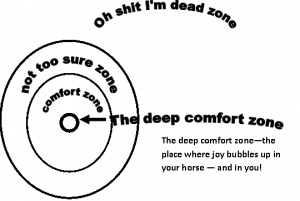
I’ve popped this in for the fence sitters particularly. It’s difficult to have Feel without paying attention to you and your horse’s Comfort Zone and here’s why. I expect I’ve talked about this before because it’s one of my common explanations – it’s the metaphor of the loud vacuum cleaner sound, drowning out the noise of the telephone ringing. The tension of the Not Too Sure Zone for too long and the mindless fear reactions of the Oh Shit Zone are the vacuum cleaner going so loud that you can’t hear the phone ringing. Either you and / or your horse being in the Not Too Sure Zone for too long or in the Oh Shit Zone regularly, risks drowning out the sensitivity of your Feel. Makes sense?
I’ve put the Comfort Zone Model here again for your convenience.
Troubleshooting
If you have trouble playing the video on my website, click here and watch it on Youtube instead.
Written Version of the Video
The most important job you will have with your horse from now on, is to notice when your horse is afraid AND TO DO SOMETHING ABOUT IT to help your horse to feel safe and because of the way you feel your connection to your horse, your own feelings of safety will depend on it.
It doesn’t matter that you don’t understand how they could be afraid of this thing, it doesn’t matter if you think their fear is irrational – it only matters that you do whatever action it takes to help them feel safe.
Here’s a diagram of the Comfort Zone Model that will help you to understand how to do that. I got this from a gifted Tasmanian horseman called Philip Nye.
Towards the centre of the circle is the comfort zone. The comfort zone is where your horse feels comfortable and relaxed – where everything is familiar and feels good and learning takes place easily in the comfort zone.
This narrow band outside the comfort zone is what we call the Not Too Sure Zone. In the Not Too Sure Zone, your horse feels a bit of tension, even a slight anxiety.
The oh shit I’m dead zone, from now on known as the Oh Shit Zone, kind of speaks for itself. I think every horse rider knows this feeling. It’s a place where our horse cannot think, they can only react with survival reactions many of which are not useful to us as riders and some of which are downright dangerous.
Spending too much time in the tension of the Not Too Sure and flipping out far too often into the fear reactions of the Oh Shit Zones is the reason that so many people think that horses are dumb creatures of routine and habit – when in fact they are amazing, thinking, responsive, co-operative beings when they are not afraid.
Us humans aren’t too smart in our Oh Shit Zones either!
Phil used to say that working mostly in the Comfort Zone and spending no longer than two minutes in the Not Too Sure Zone was a good learning program, but he is a seriously gifted horseman.
If you have a happy relaxed horse learning something new, then no longer than two minutes in the Not Too Sure Zone can work. LONGER than two minutes in the Not Too Sure Zone is a no no. Longer than 2 minutes in the Not Too Sure Zone and we are in danger of creating a HABIT of our horse feeling tense and anxious – even in a relatively relaxed happy horse.
In fact, because nobody ever told us this stuff, it’s a sad fact that MOST horses already have the habit of feeling tense and anxious in many situations that are actually routine in their lives. And it happened because they spent way too long in their Not Too Sure Zone. This chronic tension not only gets in the way of their performance, it adversely affects their ability to carry their bodies freely, causes muscle and joint problems and eventually adversely affects their health.
We can actually RELEASE old tensions from even chronically scared horses, by understanding this model, listening to them in all the ways that I talked about in the Key to the Kingdom of Horses and working their Comfort Zone with connection and sensitivity of Feel. And we’re going to talk more about how to do that in the next lesson.
The practical application of this Comfort Zone Model is that EVERY TIME YOU NOTICE YOUR HORSE IS AFRAID, YOU DO WHATEVER IT TAKES TO HELP THEM FIND A COMFORT ZONE AGAIN – ideally in seconds.
You back off, slow down, take the pressure off, change what you are doing, get off, turn around and go back to the paddock, to the field or the barn, go back towards their horse friend – whatever it is that you have to do to help them find a Comfort Zone again.
When your horse feels OK, you can stop there and wait for The Chew – that’s the validation that I talked about in the First Key – that signal of shared communication.
When you take this action EVERY TIME YOUR HORSE IS AFRAID, then the Comfort Zone will get bigger and bigger until it covers everything that you want to do with your horse.
And it gets much, much faster to put new things into the Comfort Zone as you go along and it is sooo worth it.
I apply the Comfort Zone Model to everything that I do with horses – all the time – so that relaxation and thinking and curiosity and learning easily becomes the normal thing for my horse to experience. And I take whatever time it takes for that to happen.
And believe me, once you and your horse get the hang of working like this it is sooo much faster to learn new things with your horse’s active co-operation.
It’s absolutely delicious to have your horse’s active co-operation in learning new things. It’s a very special experience.
Today’s photo:The cartoons in this clip are by the very talented cartoonist Kim Wong, who spent some time here with us as a WOOF’er a few years ago. The horse at the top is our precious Oliver, a horse with a heart as big as his 18 hands, who told me over and over and over again that there is no such thing as “wrong”.
Breathe and feel the power of that…