
A sucked into the saddle, magnetic riding seat is our foundation for beautiful riding.
Check it out for yourself here today, that most of what we were taught to do about going faster actually disconnects our riding seat.
AND I’m giving you a fabulous technique here to get a sweet transition from trot to canter.
Mannn… we have been taught some stuff about riding that makes it so much harder than it needs to be. So it makes me laugh when I put something in the category of “horse training articles”, because invariably it’s not the horses we’re training.
Take trot to canter for example. Depending on how you were taught to ride, you might have been taught to kick your horse to go faster, or to squeeze them, or maybe you were taught the more precise put one leg on the girth and the other behind the girth or even to rotate your body as a preparation signal.
99 times out of a hundred, all of these ways of getting a horse to go faster are what I call “over-riding.” They disconnect your riding seat, which disconnects you from your horse. That’s why sooo many people have trouble with their trot to canter transitions. A disconnected transition like that generally means a “less than best” canter too. And yes that’s one of my dry Aussie understatements!
A disconnected transition generally has your horse falling on their front end, which has all kinds of behavior and damaging health repercussions from the jarring in the their front end. Depending on what kind of personality they have you’ll get different reactions to them falling on their front end:
- A Flight horse personality will run faster trying to catch up to their front legs (which means you have to try to stop them from going faster and that usually means with the reins.)
- A Caretaker Horse personality won’t want to go forward properly or won’t want to go forward at all because they think you’re not safe being so disconnected from them and they’re busy trying to stay underneath you.
- A Fight horse personality who gets p’ed off enough is going to pigroot or buck. Actually they don’t need to be a Fight horse to pigroot or buck, there’s all kinds of reasons for that behavior that are addressed with the simple technique that I ‘m talking about further down.
- And I haven’t figured out the Fidget, Faint or Warrior horses off the top of my head. I’ll think on that and maybe talk about them later.
The good news is that it’s fairly easy to fix. Have a feel of all these ways of disconnection for yourself.
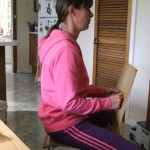
Grab a chair like Donna in the photo.
A chair is a great place to really pay attention to what your body’s doing and get the feel of something before you add the distraction of your horse. Sit facing the back of the chair, straddling it as per Donna in the picture here. Wriggle around until you feel your seat bones flat on the chair. (If you can’t get them feeling flat on the chair, grab a free ticket to the Horse Fair this coming weekend and do the riding seat lesson with me. 160 FREE presentations by some utterly awesome people.)
- Now put one leg in the position it would be on the girth and take the other leg back. Can you feel that your seat bones are no longer flat underneath you and there’s a twist in your body? First of all it actually unbalances you and it’s also confusing for a horse. Some of them have figured out what the people mean when they signal like that, but that’s down to their mind reading skills not the physical riding position. If you really need convincing, stick a couple of books under the chair leg – you’ll get the same result. Or check it out with your horse next time you’re riding.
- Try another one – move your legs in a kick and feel what’s happening to your seat bones. Apart from the unnecessary rudeness of it, it disconnects your seat doesn’t it? That means that if the horse does read your mind and go into a canter, then you’re not “together” in that canter. Does that make sense?
- Now this one – squeeze with your legs. Did you feel that disconnect too? That disconnect directly translates to being disconnected in the canter itself. Yeah yeah lots of people have brought themselves into the right position with their muscles, but they’re still needing to use the reins to get what they want because they and their horse are not together.
Try this technique to develop a perfect trot to canter transition.
All the super lovely riders make a lovely canter look effortless because a good canter IS effortless.
When you’re confident that you’re trotting along, nice and relaxed – on a loose rein, so you don’t jab them in the mouth while you’re re-wiring your canter together, just THINK about canter for a few seconds – maybe 5 seconds or so – allow yourself to feel the canter in your imagination. Nothing’s likely to happen the first time or even the second, so after about 5 seconds, go back to thinking trot and stay trotting for a while, nice and relaxed, ho hum smiling.
Then just THINK about canter again for a few seconds again, allowing yourself to feel the canter in your imagination for maybe 5 seconds or so and because it’s still unlikely that anything will happen this time either, smile a little, start thinking trot again and relax into the trotting for a while.
Repeat this as many times as you need to, to give your horse a chance to catch up to this new way of communicating. The key to success will be the clear difference between your “ho hum just trotting” thoughts and your “feeling the canter in your imagination”.
You might need to relax into YOURSELF noticing the difference between the trot and the canter in your thoughts, in which case it might take more repeats of the above for YOU to feel the difference before your horse can get clear about what you’re thinking.
There’s two things happening here:
- Horses are the ultimate mind readers.
- When you THINK about something you are engaging roughly 40% of the muscles used in whatever you’re thinking about.
After a few repeats, you’ll FEEL your horse starting to think about about it, questioning “does she mean she wants me to canter?” Maybe you’ll even feel them gathering themselves underneath you getting ready to pop into the canter or maybe they’ll even flow into the canter sweetly. Whichever happens, make it clear that yes! that’s exactly what you’re looking for – appreciate the heck out of them and tell them what an absolute star he or she is.
The canter you’ll get when you get your transitions established this way, will be a canter that comes from their back end where it should be coming from. They will have lifted their back and they’ll be able to carry you with strength and ease, for a long and happy ridden life. There’ll be a TOGETHERNESS in it, to be able to ride that canter faster or slower easily, without wrestling with the reins – probably without even touching the reins.
And once you’ve established the transition clearly like this, you can go back to adding the fancy cues that tell them which leg to lead with, how to sit back on their butt more and collect and all kinds of yummy stuff – so long as you’re not disconnecting your seat in those cues!
Before you dash off to your horse to try this, let’s check out this tension thing. Are you relaxed when you THINK about cantering?
If there’s tension in YOUR body when you even think about cantering, then you’re already communicating tension to your horse before you start – which is not useful. That’s one of my classic Aussie understatements. Communicating tension makes us think we’re crappy riders when we’re not really crappy at all – just tense, which we can fix.
If that’s you, then don’t do the canter exercise until you CAN think about it without tension in your body. I’ll give that some thought and we’ll talk about how to solve that another day!
In the meantime, pick up your free ticket to the Online Horse Fair this weekend – two days of learning that honors the horse and uplifts the rider. Don’t miss my three presentations!.
Today’s photo captured a lulu of a moment that makes me burst with pride for them. Steve was riding Oliver down the taped laneway to the big 5 acre paddock. The rest of the herd decided to go with them and started cantering past them in that narrow space. Instyead of charging off with them, Steve felt Oliver look to him and and ask “can we go too?” Steve said “no not this time” and relaxed his seat. Oliver relaxed and stayed with him mentally emotionally and physically relaxed as the other (I think there were ten) horses went cantering and then galloping past. THAT’s the kind of co-operation you get when you work with this super connected way of being with a horse.
